AI-assisted workflows
Use LLMs for extraction, classification, summarization, drafting or structured interpretation inside an existing process.
AI Automation for Business Operations
I help businesses redesign operational workflows, connect their systems and introduce AI where it creates measurable operational leverage — not simply because AI can be added.
The operational problem
Before adding an agent or automation, I identify where information originates, how decisions are made, which rules are deterministic, where exceptions occur and which actions still need human oversight.
What I build
I combine APIs, workflow orchestration, custom logic and LLM capabilities so AI can operate inside a controlled business process.
Use LLMs for extraction, classification, summarization, drafting or structured interpretation inside an existing process.
Connect agents to tools, APIs and business rules so they can support real actions rather than only answer questions.
Capture information from email, forms, PDFs and documents and route it to the right workflow.
Coordinate deterministic steps with n8n, Make, Apps Script, APIs, webhooks and custom code.
Keep review and approval at the points where judgment, risk or accountability still belongs with a person.
Restructure the underlying workflow and data so future AI capabilities can be added without increasing operational fragility.
When I’m usually brought in
I am most useful when the business does not just need an AI feature. It needs the workflow, data, integrations and decision boundaries designed so AI can operate reliably inside the process.
Email, PDFs, forms or notes repeatedly need to be read, classified, summarized or turned into structured data.
Several tools are connected, yet exceptions and unclear business rules still force people to repair the workflow manually.
The goal is not a chatbot. The agent needs access to the right systems, rules, permissions and human review points.
Operations-first architecture
I do not begin by choosing a tool. I first understand what the operation needs to control, what can be deterministic, what needs judgment and where technology can remove friction without creating another fragile layer.
Map how work actually moves, including rules, exceptions and decisions.
Create the right structure for data, interfaces, permissions and business logic.
Connect systems and remove repetitive work that should not require manual effort.
Add intelligence where classification, extraction, reasoning or assistance creates real leverage.
Proof in practice
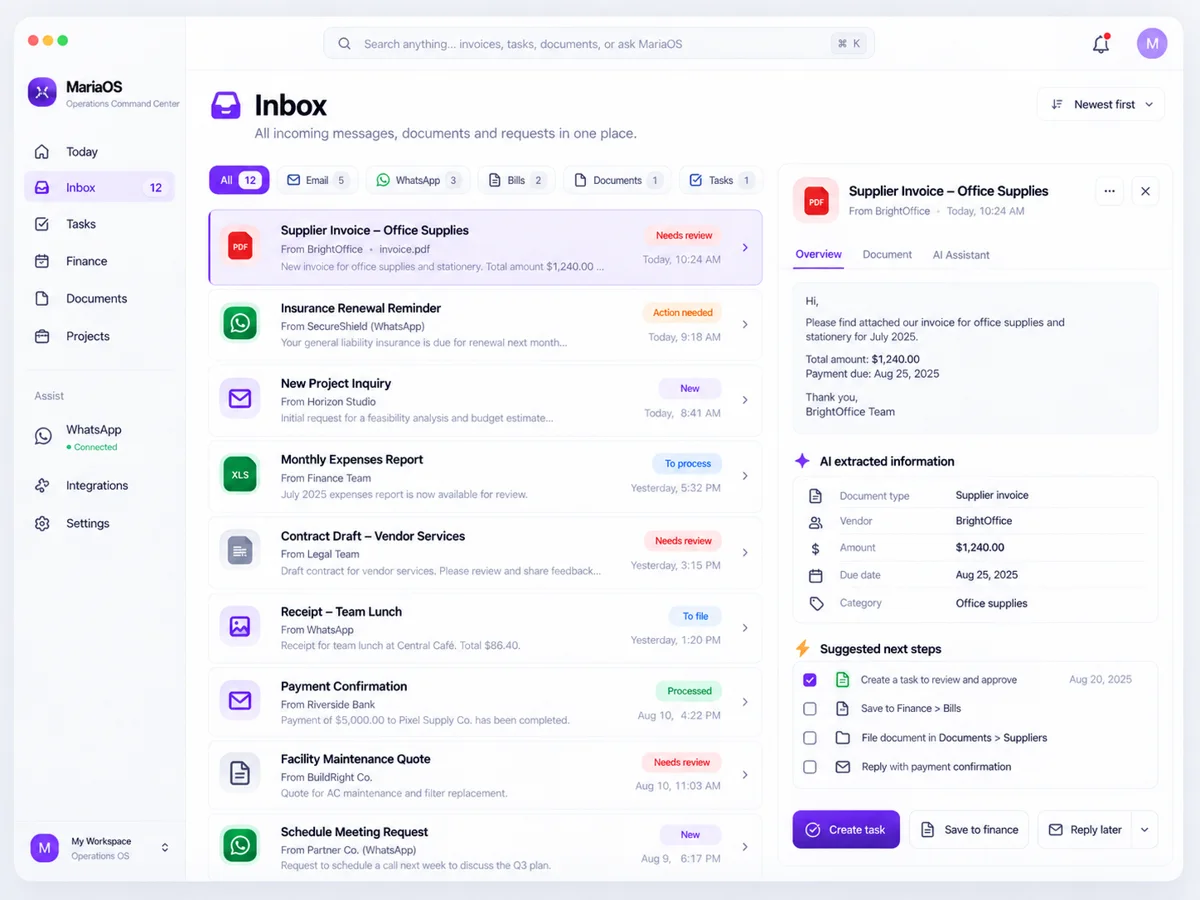
The system combines operational intake, recurring work, documents and financial tasks with AI-assisted actions. AI is introduced inside a controlled workflow rather than used as a separate conversational layer.
Result: a clearer operating environment where automation and AI support the work without hiding the underlying process.
Questions
Processes with repeated information handling, clear outcomes and identifiable decision points are strong candidates. The workflow still needs to be mapped before selecting the AI component.
Yes, when an agent is the appropriate architecture. In other cases a deterministic workflow with one or two AI steps is simpler, safer and easier to maintain.
Usually not. I prefer to connect useful systems through APIs and automation before recommending replacement.
Depending on the workflow: custom JavaScript or Python, Google Apps Script, REST APIs, webhooks, n8n, Make, LLMs and databases such as Firebase or Firestore.
I look at business risk, ambiguity, reversibility and accountability. High-impact exceptions or uncertain decisions can remain reviewable instead of being fully autonomous.
Start with the operation
Tell me where the operation is becoming difficult to control. You do not need a technical specification — the current workflow is enough to start.
Discuss your operation →