Operations dashboards
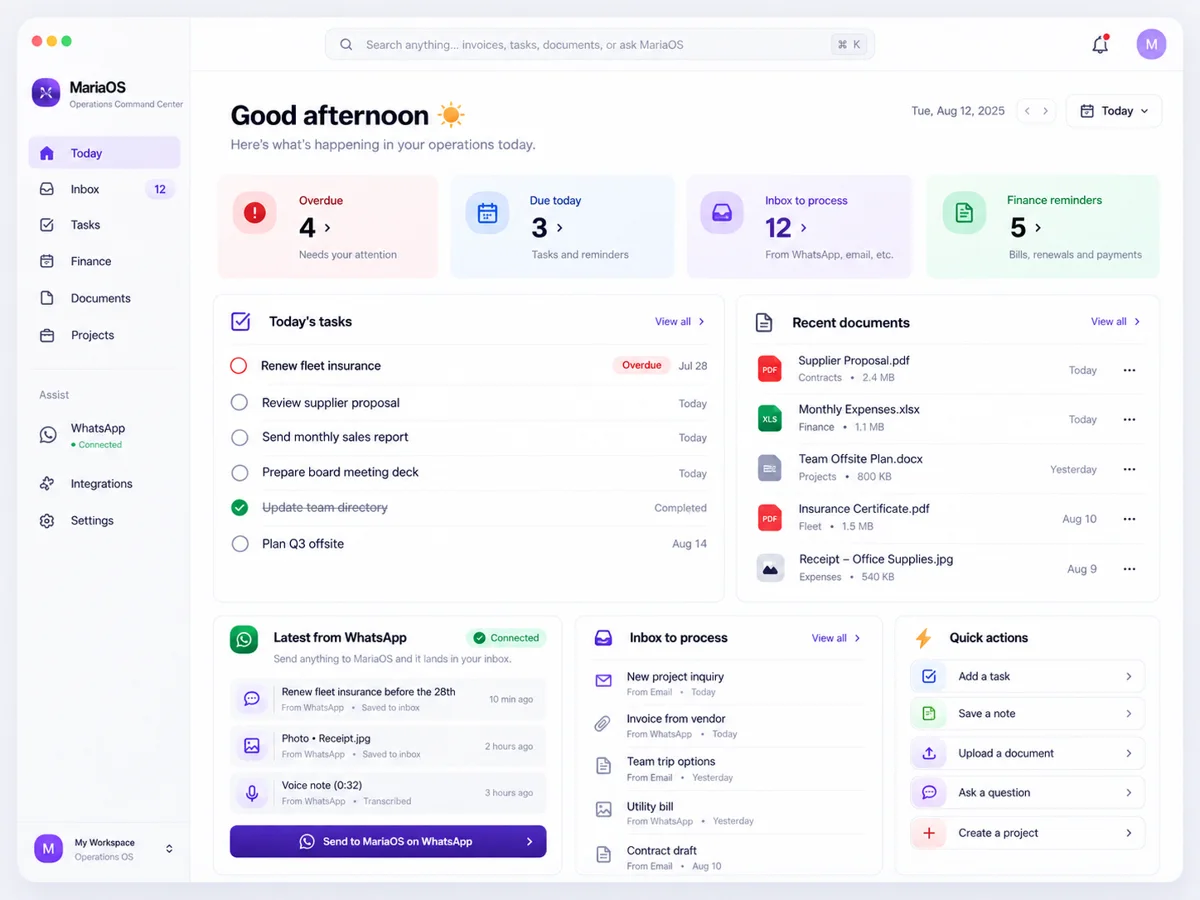
Bring priorities, exceptions, tasks and key operational information into one decision layer.
Custom Internal Tools for Operations
I design internal tools for businesses that have outgrown spreadsheets, manual coordination and rigid off-the-shelf software. The goal is one controlled system built around how the operation actually works.
The operational problem
A spreadsheet can be an excellent tool. The problem begins when it quietly becomes the database, workflow engine, task manager, approval system and reporting layer at the same time.
What I build
The right solution may be a lightweight internal tool, an operations platform, an admin interface or a connected control layer over systems you already use.
Bring priorities, exceptions, tasks and key operational information into one decision layer.
Turn recurring business processes into clear states, rules, approvals and ownership.
Give the people running the operation a controlled interface for managing data and actions.
Provide staff, vendors or partners with the right access without exposing the entire operational backend.
Normalize, reconcile, match and transform operational information that currently requires manual work.
Connect existing systems instead of replacing everything when the current stack is still useful.
When I’m usually brought in
You may not need a complete software rebuild. You need someone who can identify the real operational bottleneck and decide whether the answer is a better workflow, an integration, an internal tool or a custom application.
Too many decisions, updates and exceptions depend on a file that was never designed to run the operation.
People export, copy, message and reconcile because the existing systems only solve pieces of the workflow.
A process that worked at lower volume now creates delays, missed steps and dependence on individual knowledge.
Operations-first architecture
I do not begin by choosing a tool. I first understand what the operation needs to control, what can be deterministic, what needs judgment and where technology can remove friction without creating another fragile layer.
Map how work actually moves, including rules, exceptions and decisions.
Create the right structure for data, interfaces, permissions and business logic.
Connect systems and remove repetitive work that should not require manual effort.
Add intelligence where classification, extraction, reasoning or assistance creates real leverage.
Proof in practice
Recurring obligations, documents, financial tasks and incoming requests were spread across different tools and channels. I designed a unified operational workspace for tasks, documents, finance, intake and AI-assisted actions.
Result: one place to see what needs attention, what is due and what can be handled automatically.
Questions
When the workflow is important, recurring and sufficiently specific that generic software creates more workarounds than value. I first evaluate whether existing tools can be connected or configured before recommending custom software.
Not automatically. I first identify why the spreadsheet exists, what decisions depend on it and which parts of the process should be redesigned before anything is rebuilt.
Yes. Internal systems can sit between existing tools through APIs, webhooks, databases and workflow automation so the business can keep useful parts of its current stack.
Yes. A focused operational tool can solve one high-friction workflow first and evolve as the business proves what it needs.
No. AI is useful only when the workflow benefits from tasks such as classification, extraction, summarization or assisted judgment. Deterministic business rules should remain deterministic.
Start with the operation
Tell me where the operation is becoming difficult to control. You do not need a technical specification — the current workflow is enough to start.
Discuss your operation →